Posted by bert hubert
Tue, 05 Sep 2006 21:23:00 GMT
The move is complete. Besides the obvious stuff, this includes ADSL, IPv6 tunnel, heaps of domain names and the very server that powers this blog. You are now reading this from a closet beneath our television in Rijswijk (‘rhymes with “Nice Bike”’), The Netherlands. Thanks to my great friends over at xs4all the move happened with near zero downtime. Or to be more precise, it could’ve happened with near zero downtime.
I managed to create a tunnel from the new to the old IP address, and then changed over most of the DNS records. Extricating the server from the stunning mess of cables that had accumulated over the years took some more time though, so there was a bit more downtime than I hoped.
Anyhow, this all means we no longer have to borrow the wireless internet from our friendly neighbour ‘linksys’. Much obliged. I still feel a bit bad about this, if I ever figure out who ‘linksys’ is I’ll thank them. And give them a free lecture on securing an access point :-)
Posted in Life | 12 comments
Posted by bert hubert
Sun, 03 Sep 2006 20:19:00 GMT
Ahh.. Late afternoon Friday we got the keys to the house, which is 2.5 times as big as the old house. I should mention that the old house now feels like a shack. We moved over enough stuff on Friday so we could take out Chinese food with my brother, my uncle and my father (and Mirjam of course), which was grand.
Late night Friday we also picked up the van, a trusty Ford Transit. It took some trouble getting someone willing to rent us one, given the fact that I’ve only had a driving license for 50 weeks now, and most rental companies want you to have one for a year before you can get a van. However, a local company in Delft (‘since 1930’) thought I looked reliable enough to trust me with one.
A van is real fun. I miss it already.
On Saturday, Mirjam and I got up at 6AM and had our first van full of boxes delivered and unpacked at our new house before 8AM. Mirjam’s brother and mother arrived to help us settle, and find a place for everything, and my brother and uncle dropped in as well to fix various things. We moved over most of the big stuff on Saturday. Took out Indian food from the very good Lasanie Restaurant here. I’m somewhat of a connaisseur of Indian food, and this restaurant is very good. The ‘spent 14 hours hauling boxes’-effect might also play a part though. The Indian restaurant is actually from Pakistan btw, but let’s not get distracted!
I also had a lot of fun with our American-style two door refrigerator, which can make and crush ice. This is very rare in Europe and we would probably not have bought one on our own, but it came with the house.
On Sunday lots of odd stuff happened. We tried to drive the van into my father’s parking garage, which turns out not to be high enough for vans, except that you can drive in. Luckily I was in an astute mood, and when driving in further to get to to the right place, I heard an odd noise, so I stopped the car. The odd noise was the flexible antenna scraping some tubing. Oops. Driving back in reverse was real fun too. My father later told me many a van has made the mistake, and showed me the markings on the roof a few feet further. I’m pretty happy I didn’t trust that noise!
Then we messed up and let a supermarket trolly drive a few meters down a hill and impact a car. Oops. Contacted the owner who came to check, but couldn’t find a scratch anywhere, so wasn’t bothered. Phew.
Back to the new house for lunch with Mirjam’s sister, our brother in law, and Mirjam’s mother, who have done a stellar job cleaning and ironing all our clothes. Then to the old home to empty the attic, and disassemble and move more stuff.
How it happened exactly is not clear, but the very server that is serving these pages dropped from the attic to the floor below. A matter or 3 meters (9 feet). And get this, it survived unscathed. The case is a bit bent, and I think one of the (redundant) ethernet connectors has gone to meet its maker, but everything works, including both halves of the RAID mirror containing the root filesystem. The ethernet cable and casing probably absorbed most of the impact.
Then magic happened. We needed to move our cat, but found that the pet store did not participate in the first-Sunday-of-the-month opening, but we didn’t want to leave it behind in an empty house. So we decided to pack her into a big moving box, and secure it with lots of rope. Miep is a friendly cat, so she went into the box easily enough. We go ready the van, come back into the house, and Miep stands next to the box. Which is unaltered, all the ropes are still around it, nothing is damaged, yet the cat just sits there like nothing happened.
So then we decided to REALLY secure the box using packing foil, leaving the hand holds open of course for the air. Well, we don’t know how it happened, but she escaped from that as well, while we were driving. From that point onwards we drove very carefully as we did not want anything to move in the back and harm the cat. She’s still recovering here, moving is a very stressful experience for a cat anyhow..
Back in the house my father dropped off some gardening equipment, and we had yet another great take-out dinner (pizza & pasta).
Then I returned the van, where a friendly looking person without any company clothing on the street asked me for the keys of the van. So I asked him if he actually worked there - turns out nobody had ever done that before, and the guy had been there for quite some time alreadybut his outfit wasn’t ready yet. They were impressed though, as they have had cars stolen by people attaching fake key ‘drop off’ boxes for cars delivered late, but they hadn’t thought of this angle yet. But I bet that if you print an overall with the company logo, you could have a ball.
All in all, things went well, but I really hope we won’t have to move anytime soon, it is hard work!
Posted in Life | no comments
Posted by bert hubert
Fri, 01 Sep 2006 14:14:53 GMT
After what seems like an eternity, and passing many many hurdles, some administrative, some legal, we now hold the keys to our new house!
Posted in Life | 6 comments
Posted by bert hubert
Sat, 26 Aug 2006 18:53:00 GMT
Steorn
The Steorn thing mentioned in my previous post appears to be going strong, quite a number of people have been investigating the company and their claims. Given the statements made by Steorn, things discovered about their past, the nature of their actions, three possible situations remain possible:
- They have found something real
- They are really really crooked and onto their last straw, and haven’t thought it through
- They are deluding themselves
Situation 1 would be cool. Situation 2 requires them not to be thinking straight - it appears they are not going to be accepting or even seeking any money unless their technology is vindicated. Situation 3 has happened in the past. It might be that some of their engineers are faking measurements, and have convinced the rest of the company.
I’m afraid it might be 3, but 1 is still a real possibility. There has been some speculation on forums that the physics of permanent magnets isn’t as solid as you might think.
A nice quote by Tatiana Makarova of Umea University, who has discovered the first carbon magnets:
“Only a few people understand or think they understand how a permanent magnet works,” says Makarova. “The magnet of everyday life is not a simple thing. It’s a quantum-mechanics thing.”
So it is not that outlandish that something might be hiding in there. I’ve tried to follow carbon magnet research a bit, it appears that as of 2006 it has been confirmed abundantly, but not explained. More detail here.
All very interesting. One sad possibility is that the Steorn device might only be cooling the air around it a bit, because of thermodynamic effects of magnetic domain randomisation/ordering.
It appears the Steorn people are aware of this possibility though, given how they stress a full thermodynamic evaluation will be needed.
Posted in Life | 36 comments
Posted by bert hubert
Sun, 20 Aug 2006 12:25:00 GMT
Regular readers of this blog may know I have an interest in new physics, or
as some of my learned friends call it, fringe physics, the latter not being
a positive connotation.
This week a company called Steorn took out a full page advertisement in the
Economist, a respected newspaper, announcing their invention of a ‘free
energy’ device. Part of the exact text of the ad reads:
“Imagine - A world with an infinite supply of pure energy. Never having to
recharge your phone. Never having to refuel your car”.
To validate their bold claims, they are seeking twelve “most qualified and
most cynical” scientists. We are told a number of physicists have already
investigated their device, but are unwilling to go on the record with their
endorsement.
Now, does all of this make sense? Is it a setup, or a scam, or a bunch of
delusioned people?
(Update: ok, I have a theory based on research reported on the Wikipedia. It appears the company Steorn is somewhat defunct, and may have in fact been empty. One thing that might have happened is that someone took over this empty shell, and is using it to launch a kind of ’Space Cadets’ TV show. This is exacerbated by the fact the the advertising agency that does the Steorn promotion is also used by ITV. See this article).
The media has already sought and found a number of scientists willing to say
it can’t possibly be true, with choice quotes like “Irish energy miracle ‘a
joke’”.
State of Physics
This article isn’t really about the possible veracity of their claims, but I
do want to say a few things about the state of physics.
Arthur C. Clarke said in 1962:
“When a distinguished but elderly scientist states that something is
possible, he is almost certainly right. When he states that something
is impossible, he is very probably wrong.”
Over the years this dictum has changed, and we can safely remove the word
‘elderly’ from the above. For the past half century, physics has mostly been
about adding more decimal places to known science, while studiously ignoring
things that distract from the grandour of the fine laws of physics.
And indeed, the cries of ‘impossible’ are heard a lot, and again in the case
of Steorn. They might well be correct. But physics is no longer the secure
place it once was. Breaking the speed of light is also impossible, but when
that same speed became an impediment to the ‘big bang’ model of physics, it
was quickly decided that, well, if we’d have to otherwise rewrite all our
laws, then the speed of light CAN be broken.
This is called the inflationary theory of the creation of the universe, and
it is currently the most widely supported explanation of the big bang. From
the Wikipedia entry on the ’Inflationary Epoch’:
“Most scientists estimate the duration of the inflationary epoch as 10^-32 of
a second. During this time, the size of the universe increased by a factor
of 10^50 from an initial size of 10^-26 meters in diameter (a hundred billion
times smaller than a proton) to approximately one hundred million light
years (10^24 m) in diameter.”
This is then usually followed by a vigorous handwaving, meant to distract
the reader from the fact that we’ve just broken the very laws of physics we
are trying to save:
“This exponential inflation solves many of the problems of a simple big
bang, such as the flatness problem and the horizon problem.”
In the same way, the world of physics is currently straining to explain a
rather large number of anomalies, like what is causing the universe to
expand in the way it is. This has led to the invention of ‘dark matter’
(regular matter hidden in the universe, that we don’t see because it emits
nor reflects any light), which is not too controversial, but the sums still
didn’t work out. So ‘dark energy’ has been posited to make everything fit.
The problem is that said dark energy can’t very well exist under our current
laws, as it is supposed to exert ‘negative pressure’, acting as a sort of
negative gravity. And it has to be 70% of the mass of the universe.
Furthermore, precise and decade long measurements of space probes show they
are moving in different paths than they should be, both when passing very
quickly and closely to the earth, and when they are very far away. The
anomalies are small but highly persistent. See
Is the physics within the Solar system really understood?, and the Wikipedia entries on the flyby anomaly and on the Pioneer anomaly.
To wrap this all up, the current state of physics is not solid enough for
bold “Impossible!” statements, because impossible things are rather
regularly posited to make up the gap between reality and current laws of
physics.
Steorn’s challenge
Let’s assume they honestly believe they’ve found something. How would we go
about things? It stands to reason they want to make money from their
invention, history has been unkind to inventors hoping to get their just
rewards without also being good business people.
Also, many inventors have gone crazy and rushed out with bold claims which
later proved to be hard to validate. In the current conservative science
climate, if a third party makes a single failed attempt at replicating the
claim, you are effectively excommunicated.
The problem is that any new physics is bound to be somewhat tricky to show,
because if it weren’t, we’d have noticed the ‘new’ effects already, and they
wouldn’t be new.
The situation can be compared to making a souffle, which is notoriously
difficult to do right. Everything has to be just so, otherwise we don’t end
up with a fluffy and delightful meal, but a soggy wet mess.
Let’s say you have a physicist friend, and you describe him the joys of a
souffle, and he doesn’t believe a word of it, and requests the recipe. Still
not believing a word of it, he’ll head to his kitchen, and lo, he ends up
with a soggy wet pie.
And if this happens with your ‘new physics’ experiment, you are toast. We
all know souffles exist, and in this case, he probably did not get
everything “just right”, probably not helped by his staunch disbelief.
But in the world of physics, anybody having made a bold claim that could not
be (fully) validated instantly is shunned. Recent history is rife with
experimenters being researched for fraud, and being evicted fromt their
universities. Doing new physics is a career limiting move.
So, imagine we are Steorn, and we honestly believe we’ve hit something new,
now what. Their claim that physicists have already looked at their claims
but refuse to go on the record is highly plausible, for the reasons
described above.
However, from this we can probably also derive that their effect can’t be
stunningly obvious, as in that case they’d be able to just present people
with the aforementioned phone that never needs recharging.
Their current actions best fit the situation where they have a small effect
that they believe can be scaled up to something real with the right amount
of investment, which they might be able to attract if they can find
“respected scientists” to sign off on their current results.
I’ll be following this exciting “Willy Wonka” like event for as long as it takes, expect more posts.
In the meantime, the theory that this might all be a scam is not too plausible, Steorn has existed for a while now, the people involved appear to be real, they’d be throwing away a lot. More information is appearing on the Wikipedia Steorn entry all the time, it might be interesting to watch that too.
Posted in Life | 39 comments
Posted by bert hubert
Mon, 14 Aug 2006 16:46:00 GMT
As previously noted, Sun is making a SunFire T2000 server available permanently for PowerDNS development, which should be good for all PowerDNS users, and probably for Sun as well. With a big PowerDNS user we are currently investigating an interaction between PowerDNS, Solaris and its Completion Ports, which may turn out not to be a PowerDNS bug. So everybody wins.
The server is arriving tomorrow at the PowerDNS offices, we hope to have it up and running shortly.
Ok, some more spiffy ‘before and after’ graphs, this time from a Solaris 10 user:
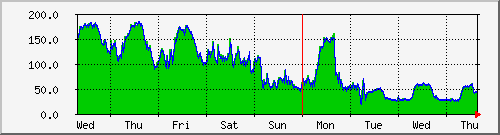
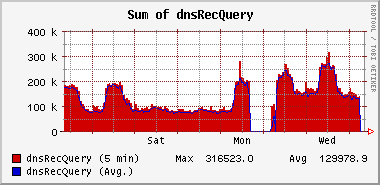
The lower graph lists the number of queries per 5 minutes. In the lowest graph, it can be seen that just before and after the maintenance period (the white bit around Mon), the number of processed queries went up substantially.
The upper graph is a plot of the load average of the server in question, which can be seen to drop visibly after this period. It is probably best to concentrate on Friday vs Wednesday. Friday, which is non-PowerDNS, did 200kqueries in 5 minutes in peak, at a load of 1.75 at peak.
The next Wednesday, we see a peak of 300kqueries in five minutes, with a load of 0.6 at peak.
If we combine these numbers, we see the efficiency (queries divided by cpu load) go up by a factor of 4. It should be noted that this is a dual CPU machine, which explains why the load can exceed 1 when running a single name server.
Thanks to Jan Gyselinck for these graphs.
Posted in Linux, PowerDNS, Netherlabs | no comments
Posted by bert hubert
Wed, 09 Aug 2006 21:04:00 GMT
(Update: I’ve upgraded my Ruby on Rails, thanks for warning me! See here)
Well, big news, we’ve decided PowerDNS needs a new homepage, and that it needs to tell you why you should run PowerDNS. All pretty obvious of course, but it took us some time to realise PowerDNS use is spreading purely based on word of mouth, and not because we promote it so well (which we don’t).
The main page currently projects a sort of post-dotbomb shareware image. The wiki is fine as it goes, but only suitable for hardcore developers. And finally, the documentation contains lots of gems on how to best use PowerDNS, but it is all very spread out.
So, until we have our new homepage, some promotion. A large PowerDNS deployment is set to make 120 servers redundant. In energy costs alone this should save around 100kW, continuously (Update: ok, perhaps a bit less. Allow me some artistic license here. If you include cooling, it is not that far off.) . For reference, that kind of power requires four of these to generate:

We might as well follow Sun’s lead and rename PowerDNS ‘The most Eco Friendly Nameserver’. EcoDNS has a nice ring to it.
Some more promotion. Switching to PowerDNS does not just save the environment, it also makes your mail go faster. A happy PowerDNS user sent us this graph:
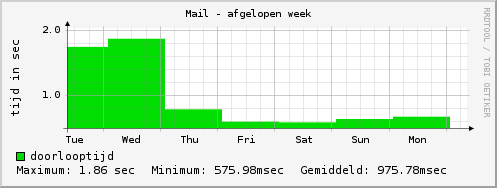
This says, in Dutch, “average mail delivery time, in seconds”. Note the dramatic shift very early Thursday morning, from around 1.8 seconds to 0.8, and later around 0.65-ish.
The almost threefold speedup happened immediately after the switch to PowerDNS. This makes some kind of sense, with the massive amounts of spam these days, a mail server can spend an awful amount of time trying to resolve strange sender addresses, and traversing often very bad or weird reverse delegations. Spammers have also been known to try to make their DNS so misconfigured that DNS-based filtering attempts fail.
No matter what the exact cause is, there is a nearly threefold speedup. Made all the more spectacular by the non-zero based graph!
We’ll try to move the hype from here to serious white papers on the new homepage. But it feels good to share some of the improvements people are achieving by switching to PowerDNS.
Posted in Linux, PowerDNS, Netherlabs | no comments
Posted by bert hubert
Wed, 02 Aug 2006 21:54:00 GMT
Quick note. If you’ve sensed a disturbance in the force, it is because tens of millions of internet connections moved to PowerDNS just now.
I still have goosebumps.
Posted in Linux, PowerDNS, Netherlabs | 1 comment
Posted by bert hubert
Sat, 29 Jul 2006 12:09:00 GMT
Just got back from holiday, sadly on the same day as family member was admitted to the hospital, but that should not taint our massively succesful vacation!
For the first time, Mirjam and I were able to take our own car and drive it around Europe. Years ago our parents showed us (independently, we didn’t know each other then) the pretty places to visit in countries near and far, it is really a great feeling to be able to go out ourselves now!
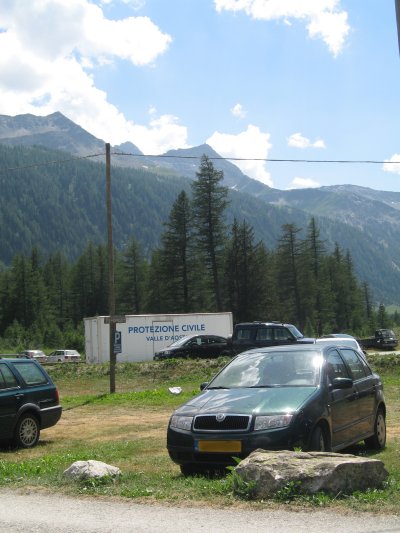
Here’s a picture of our Skoda to a spectacular backdrop, and a mysterious container for ‘civil protection’:
 .
.
Due to the heatwave in Europe, we’ve only stayed on campings above 500m, ending up at 1500m, which meant the temperatures were nice. We started at the Heidenkopf campsite in the The Elzas, which was very fine except that the sanitation is in need of modernization.
After two days there we moved to a campsite on the border between France and Switzerland. At this time, I have to explain we went on vacation with only one passport, Mirjam having lost hers a few days before we left. Most EU countries, and some non-EU ones, are members of the Schengen agreement, which means that as a rule, passports are not checked on borders. And indeed, you can pass the Dutch/Belgian border at highway speeds. There is a sign, but that’s about it.
However, given the current “security” climate, we had some fear we’d get into problems. We need not have been afraid, our 15 days of vacation passed without anybody asking for a second piece of identification. All hail the EU, in this respect.
There was some residual fear though, most European countries demand that people be able to identify themselves though. But this didn’t happen.
Ok, so we went the the ‘Haute Jura’, which stretches out over France and Switzerland. And we have a satellite navigation system.. that knows nothing about countries. It does know a good road when it sees one though, and the ones in Switzerland in that area are superiour to those in France. So given any chance, the navigation computer sends you to Switzerland, even when your final destination is in France. Switzerland, while a member of the Schengen agreement, does have serious border control. Furthermore, Swiss highways are very expensive to drive on, requiring a certificate.
I think we’ve seen half a dozen Swiss border posts while in the Haute Jura, they crop up everywhere! In the end we discovered the routes that stayed in France though.
After a few days there, on a rather Disneyfied campsite that had recently (it appears) been acquired by a large company with the interesting name of Homair, we left for our final destination, Courmayeur in Italy, as suggested by my father.
Courmayeur sits on the Italian side of the Mont-Blanc tunnel, and is at a height of around 1500 metres, as is the excellent La Sorgente campsite. The pictures linked to this post are from there.
We spent 6 days excellent there, and then drove back, staying the night in a very fine St. Martin (Logis the France) hotel, in a village of 280 people. It did serve a four course dinner with excellent wine and cheese though.
On driving back, Mirjam and I remarked that it got awfully hot in the car. When we stopped for one of our frequent breaks, we saw a newspaper with ‘39C in the shade’ filling most of the front page (around 102F) - we thought it was just us having a hot car.
Camping
People either love or hate it. I think a fair amount of emotion is involved - when you mention you had a great time camping, you often encounter people gushing to share horror stories with you how everything went wrong when they tried it. The passion with which these feelings are shared is stunning, it must hit something deep.
I’ve long learned not to try to convince these people, but it hurts me to know what they are missing!
First, a picture to show what I mean:
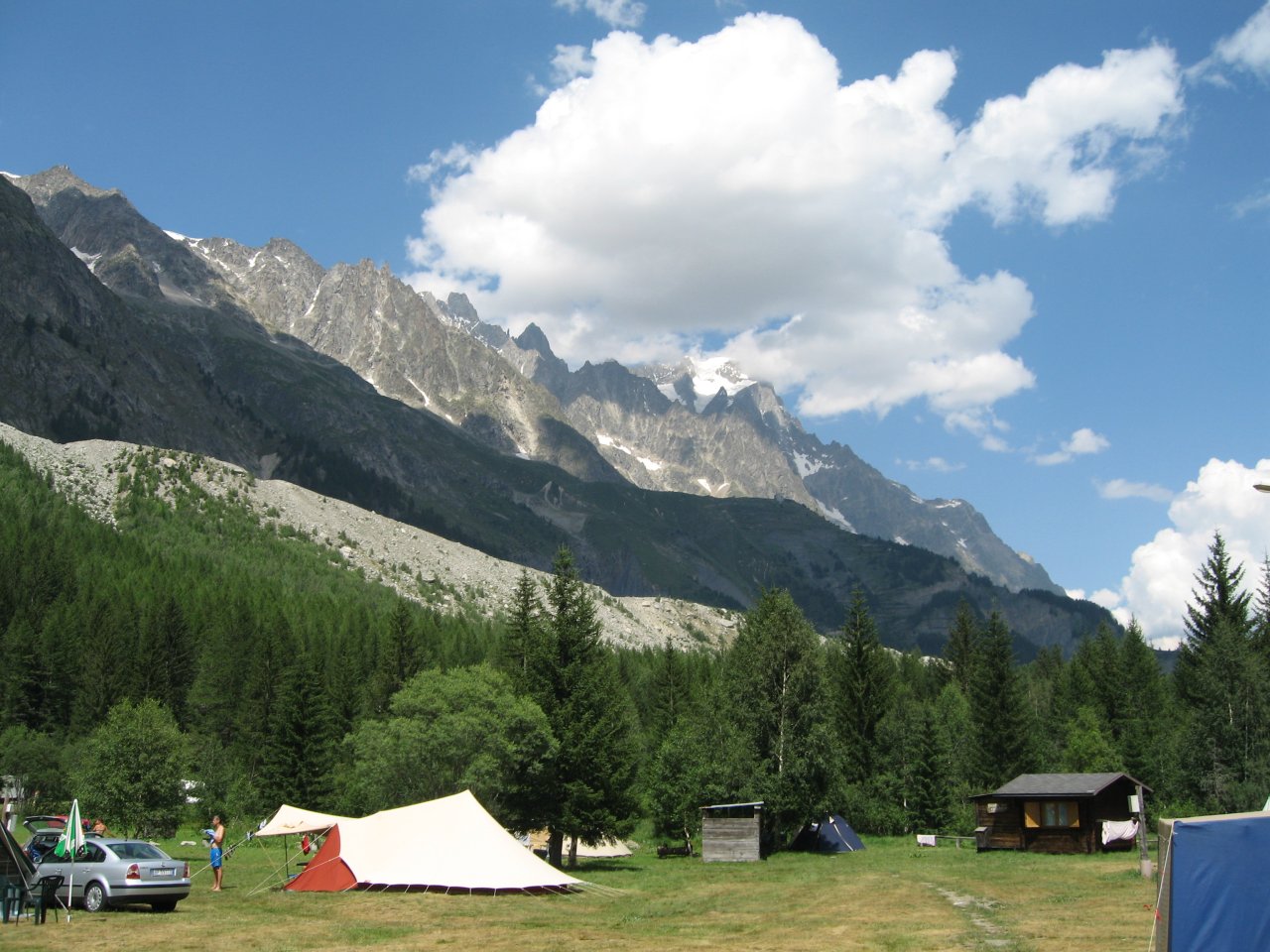
Our tent is the small one hiding under the tree. Imagine waking up to that sight. Pick up bread and croissants from the little shop, make some coffee, bake an egg, and just let the scenery work on you.
There is a sort of magic on these campsites. There are lots of people, and it is nice to see them enjoying their vacation. You could talk to them, if you wanted, but you could also stick to friendly greetings, it is fine either way.
I think these other people serve as a sort of backdrop for my relaxation. For some reason, I am relaxed the minute I sit before a tent. It would be good to figure out why this is, it might help me relax during the rest of the year.
But back to the magic - it is like living in the 1950s I think. If you pick the right campsites, and this is vital, you’ll encounter a politeness rarely seen in large countries anymore. People move around carefully not to violate each other’s space, children play making joyful noises, but there is no loud music, no racket.
When people go out, they leave their tent nice and neat. Nothing obsessive about this, but in places like these it is extraordinary to not clean up before going away.
If it suddenly starts to rain, you can rest assured neighbours who remained on the campsite will notice if you’ve not closed your tent properly, and close it up for you. If a storm picks up, people will more often than not take down any parts of your tent or caravan unable to deal with the weather.
But at the same time, there is lots of privacy.
What to do
In most surveys, people tend to state that they are very active on vacation. Hiking, visiting museums, mountain climbing, diving, swimming etc are all named. Recently, there was another survey here in The Netherlands which was probably more cleverly worded, I’m not sure how they did it, but the result was that what most people enjoy doing most on holiday is… nothing (and reading).
I’ve long thought this. Hiking is fun, walking is fun, swimming is fun, the occasional museum is fun, but in the end most people, including me, just need to relax. Vacation is not work. Note that there are people who are so full of energy they can’t sit still, I hope they can relax by being active.
However, all this leaves the question, what to do for the time you are not doing any of these active things. The good news is that camping offers lots of opportunities to constructively waste time. For a start, you can spend a lot of time on cooking or otherwise preparing food. Because there is less equipment to work with, this can take as much time as you want.
In order to cook, you need to discover the local shops and/or supermarkets, which can be very exciting if you are abroad. There is bound to be stuff for sale you’ve never heard of, but which might be delicious. In Europe, for me this goes especially for France, Portugal, Spain and Italy.
Then there is the business of keeping your tent and other equipment in shape.
Before you know it, you’ve whiled away another day in serious relaxation.
Also, if you want to go do stuff, it is easy to do. In fact, due to the incredible freedom of camping, you can hop around. Want to climb several mountain ranges? By all means.
We mostly go camping with the goal to walk a lot, in practice this depends highly on what we feel like. It doesn’t really matter, you’ll rarely go bored camping.
Some tips
Ok, I can’t resist, I need to evangelise camping a bit more. I’ve heard all the horror stories from people who tried, and yes, you can mess up in a big way. Contrary to what people think, camping is not generally cheap. It can be if you know what you are doing, though.
Examples of messing up include going out with ‘stay over’ sleeping bags, which have been washed 25 times at home and are therefore severly degraded. Or borrowing a 25 year old tent from someone. Or bringing a matrass that leaks or is too thin. Or trying to erect a tent after driving a 1000km. Or picking a campsite at random and ending up with football hooligans looking for a cheap place to sleep. There are some really horrible camp sites out there.
So, here is my advice if you want to try camping:
- Find a friend who is experienced, and use him or her as a guide.
- Take extraordinary care in selecting at least the initial campsite. Preferrably ask your friend for a favorite. Invest in a good camping guide. In Europe the German ADAC ones are great. This will allow you to select a campsite that suits your needs. If you want a quiet place, select sites without disco, animation, etc. Do pick top-notch sanitation.
- You need excellent equipment. For example, modern tents are cheap, lightweight, breathe in fresh air, are extremely water tight, easy to set up, but something has to give. The dark secret is that most modern tents only last 5 or 6 long seasons. So if you decide to borrow a tent, make sure it is still in great condition. Same goes for sleeping bags, matrasses etc. This is one of the easiest ways to mess up.
- Be sure to arrive at your chosen campsite at a reasonable hour, preferrably without having exhausted yourself behind the wheel. This serves two purposes, you’ll have an easier time erecting your tent but you’ll also have a chance to find another campsite nearby if the first one disappoints, or is full.
- By all means bring a table and chairs. Also consider investing in a decent coolbox or even a refrigerator. Doing without these things seriously makes life harder. There are die-hard campers that do without all these luxuries, and I wish them good luck, but it is not for me. I like my eggs unhatched and my beer cold, and preferrably on a table!
If you have any questions, feel free to email me on bert.hubert@netherlabs.nl.
I’ll miss camping until next year…
Posted in Life | 1 comment
Posted by bert hubert
Tue, 11 Jul 2006 06:41:00 GMT
Ok, I no longer think spammers should be shot. I now think they should be force fed their own intestines, and THEN be shot.
I’m usually a friendly kind of person, but I now estimate that I lose around 5% of my productivity on cleaning out spam from Wikis, bug trackers or mailing list queues, not even mentioning deleting unfilterable spam from my own mailbox.
The latest thing has been spammers who not just tack on advertising to the fine PowerDNS wiki, but actively delete existing content and replace it by their own advertising.
Perhaps Guantanamo does have a purpose.
Mortgage
Well, it turns out banks aren’t crazy (see previous post). If you negotiate a cut rate mortgage, they’ll start to eliminate risk left and right, because the deal is not worth it for them otherwise.
I’ve now had to provide documentation on my father, brother, all real estate agents involved, shoe sizes, and loads of other crap. Next I think they’ll ask for my swimming certificate. But they are now committed, in that they’ve provided the all important guarantee on the 10% downpayment. Which is good as it was due today :-)
Posted in PowerDNS, Life | no comments

